 Luno
Luno fees turn a quoted crypto price into a complete transaction cost
Luno fees vary by transaction route, account region, payment method, exchange fee tier, and blockchain conditions. To calculate a complete cost, start with the instant quote or executed exchange order. Then add any deposit, cash withdrawal, or crypto send charge that the chosen route actually uses. Compare alternatives by the net crypto received after a buy or the net cash received after a sale, rather than one displayed percentage.
Quoted Purchases and Exchange Orders on Equal Terms
A like-for-like comparison starts with the same spending amount, account region, asset, and intended exit for both routes. Changing any of those inputs changes the question being answered. A purchase that remains in a Luno wallet does not carry the same cost path as one followed by an external crypto send.
An instant buy or sell quote displays an exchange rate, any quoted transaction cost, and the exact crypto amount involved. On Luno Exchange, the execution price comes from the order book, while a maker or taker rate applies to the executed trade. A low trading rate does not establish the cheaper route if the execution prices or final outputs differ.
Use the final crypto output for a purchase and the final cash output for a sale.
If one route begins with an existing wallet balance while another requires a new bank deposit, add the funding charge only to the second route. Apply the same rule at the exit. A crypto send fee belongs to a route ending at an external wallet, while a cash withdrawal charge belongs to a route ending at a bank account. Keeping the destination fixed prevents a misleading comparison.
Which Charges Belong in the Total?
The total contains only charges triggered by the chosen path, measured on one consistent basis. Separate each line before doing the arithmetic because some costs reduce the funding balance, some reduce the crypto received, and others appear only when funds leave the platform.
- Funding cost: any deposit or payment-provider charge applied before cash reaches the wallet.
- Trade cost: the instant transaction cost shown in the quote or the fee on an executed exchange order.
- Cash exit cost: the applicable charge for withdrawing local currency to a bank account.
- Crypto exit cost: the displayed send fee for the selected asset and supported network.
- External cost: a charge imposed separately by a bank, payment service, or receiving platform.
For a purchase held inside the account, add the funding fee to either the instant transaction cost or the exchange execution fee. Do not add both trading models to the same trade. A round trip to cash also includes the sale cost and cash withdrawal charge. A route ending at another wallet uses the crypto send fee instead of a bank withdrawal fee.
The quoted exchange rate still affects value even when it is not labelled as a separate fee. Compare the exact output as well as the itemised charges.
Worked Cost From Funding to an External Wallet
Every changing figure in this worked calculation is hypothetical and expressed in the same local-currency equivalent. The starting transfer is 873 units, the deposit-provider charge is 3 units, the instant purchase cost is 17 units, and the displayed crypto send fee is equivalent to 8 units. No cash withdrawal occurs in this route.
- The entry condition is a supported funding method and a local-currency wallet that can receive the deposit. After the hypothetical 3-unit provider charge, 870 units reach the local-currency wallet.
- The purchase quote shows the hypothetical 17-unit transaction cost and the exact crypto output. Accepting it changes the account from a cash balance to a recorded crypto purchase. Funding and trade costs now total 20 units.
- Before confirmation, verify that the send network matches the destination, review the destination details, and confirm the hypothetical 8-unit fee. The crypto balance must cover both the intended transfer and that fee before confirmation.
- The exit condition is a send record and a credit at the intended destination. Explicit costs total 28 units, leaving 845 units of local-currency-equivalent value attributable to the delivered crypto before any market-price change.
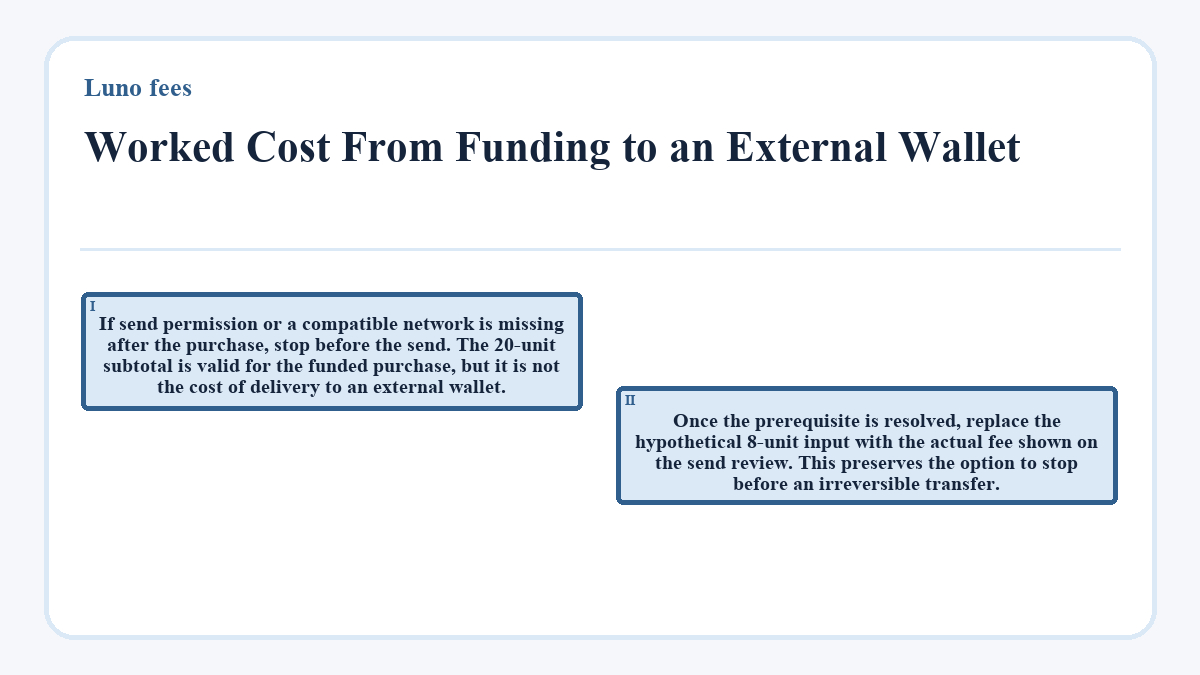
If send permission or a compatible network is missing after the purchase, stop before the send. The 20-unit subtotal is valid for the funded purchase, but it is not the cost of delivery to an external wallet. Once the prerequisite is resolved, replace the hypothetical 8-unit input with the actual fee shown on the send review. This preserves the option to stop before an irreversible transfer.
How Do Maker and Taker Rates Change the Trade Cost?
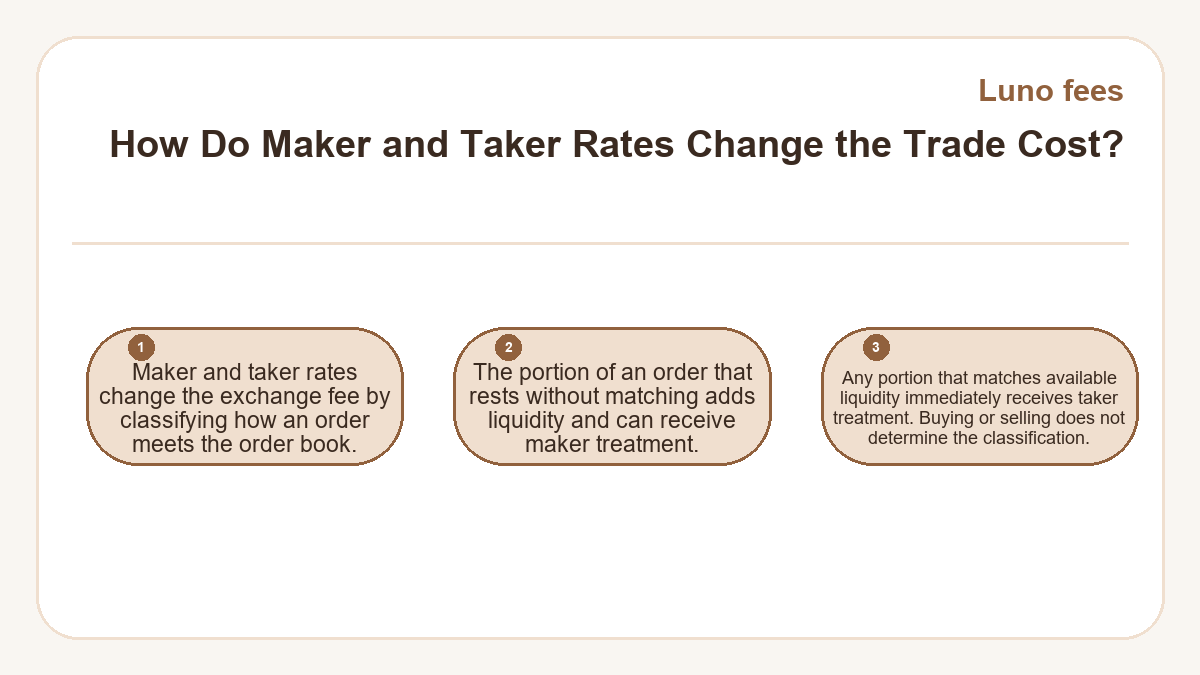
Maker and taker rates change the exchange fee by classifying how an order meets the order book. The portion of an order that rests without matching adds liquidity and can receive maker treatment. Any portion that matches available liquidity immediately receives taker treatment. Buying or selling does not determine the classification.
A market order is a taker order because it seeks immediate execution against available orders. A limit order does not automatically qualify as maker activity. If its price crosses an existing order, it can execute as a taker. A post-only order avoids taker treatment by being cancelled when it would match immediately, although that protection also means the trade may not occur.
The applicable rate can depend on the verified account region, market, and rolling 30-day exchange volume. Some schedules can include zero maker rates or maker rebates. Compare the rate displayed for the relevant market and tier, then apply it to the executed trade value. An open order has no completed trade value to include in the cost total.
Funding, Cash Withdrawal, and Crypto Send Charges
Deposit and cash withdrawal charges follow the verified country, available payment method, and provider arrangement. A method may be free, carry a flat charge, or use a percentage under its regional schedule. Transaction limits can also make a nominally cheaper route unusable for the intended amount. Record the amount requested, the amount credited, and any separately displayed provider charge.
A crypto send has a different cost structure. The displayed fee can change with blockchain demand and, for some networks, the destination address. It can also include Luno's operating costs for processing the transfer. The on-chain component covers transaction processing under the network's fee rules. Other portions can cover service-provider, address-creation, or wallet-transfer costs. This is why a block explorer may show a network fee below the total charged for the send.
The exact send charge appears before confirmation. It must be measured in the asset charged or converted to the same accounting currency used for the comparison. Network compatibility remains a prerequisite: a cheaper fee does not make an unsupported or mismatched network usable. Crypto sends are generally irreversible after submission, so cost comparison belongs before confirmation.
When Is the Lowest Displayed Fee Not the Cheapest Route?
The lowest displayed fee is not the cheapest route when another price or charge produces a worse final output. An exchange order with a low fee can execute at a different effective price from an instant quote. A low purchase cost can also be outweighed by an expensive deposit, cash withdrawal, or crypto send that the alternative route avoids.
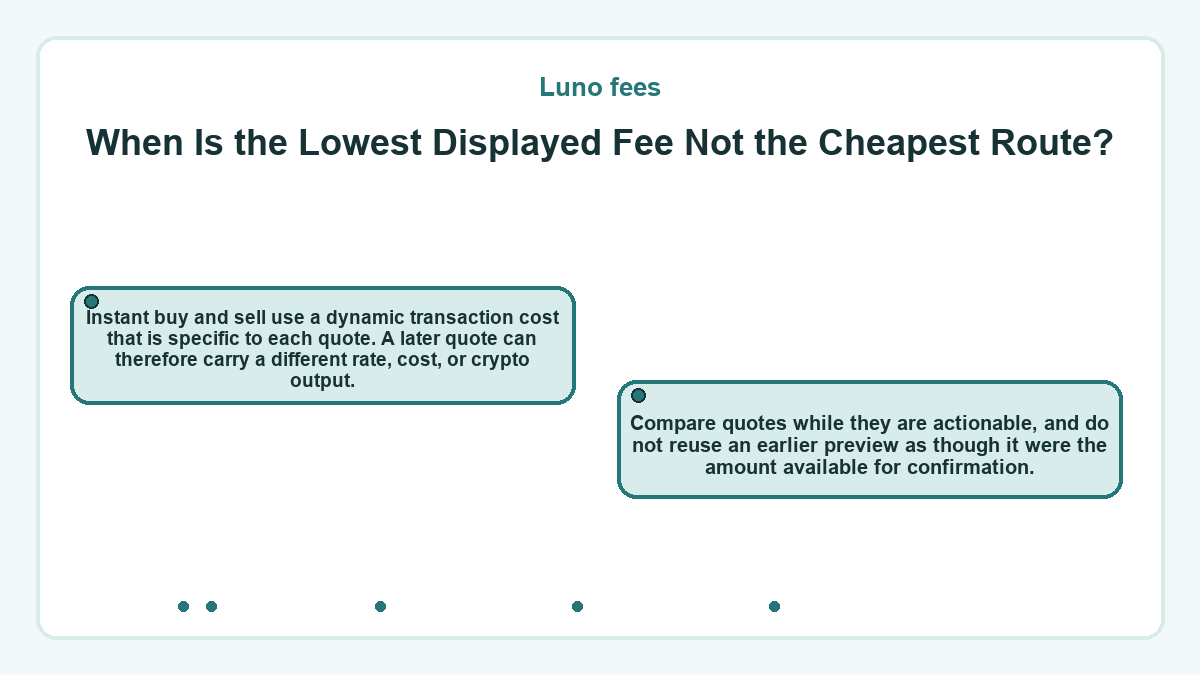
Instant buy and sell use a dynamic transaction cost that is specific to each quote. A later quote can therefore carry a different rate, cost, or crypto output. Compare quotes while they are actionable, and do not reuse an earlier preview as though it were the amount available for confirmation.
Before committing, reconcile the starting funds, credited deposit, trade output, trade charge, and intended exit cost. If one required amount is unavailable, the full comparison remains provisional. After execution, replace preview figures with the transaction record and actual balance change. The lowest-cost route is the one that delivers the greater net amount at the intended endpoint under the same conditions.
Practical questions about Luno fees
When Does the Luno Inactivity Fee Apply?
The inactivity fee applies only when an account has gone 12 consecutive months without a qualifying transaction and still holds an active local-currency balance. It is charged monthly from that cash balance, is capped by the cash available, and does not reduce cryptocurrency holdings. A qualifying transaction, deposit, or cash withdrawal resets the inactivity period.
Why Has My Exchange Fee Tier Not Updated After a Trade?
Luno calculates the 30-day exchange volume used for a fee tier once per day, rather than after every fill. A newly completed trade may therefore appear in the next daily calculation. The applicable schedule depends on the verified account region and market, while the tier uses total 30-day Exchange activity across the markets available to that account.
Which Balance Pays an Instant Buy or Sell Transaction Cost?
An instant buy or sell transaction cost is taken in cryptocurrency and calculated from the amount being bought or sold. The quote shows the exact crypto amount and cost before confirmation. Deposit or withdrawal charges can instead affect the local-currency wallet, depending on the payment method and regional schedule, so each line should be recorded in its own denomination.
Does Receiving Cryptocurrency Carry a Luno Fee?
Receiving cryptocurrency is generally free on Luno, but very small deposits can face asset-specific minimums or a dust-related charge. The sender may also pay a network or service fee before the transfer reaches Luno. Compare the amount sent with the amount credited and check the applicable asset conditions when a small receipt appears short.
Why Can One Limit Order Contain Both Maker and Taker Fees?
A limit order can have both classifications when one portion matches existing liquidity immediately and another portion rests on the order book before filling later. The immediately matched portion is treated as taker activity, while the resting portion can be maker activity. The transaction history is the reliable place to reconcile the executed portions and their fees.
Updated -